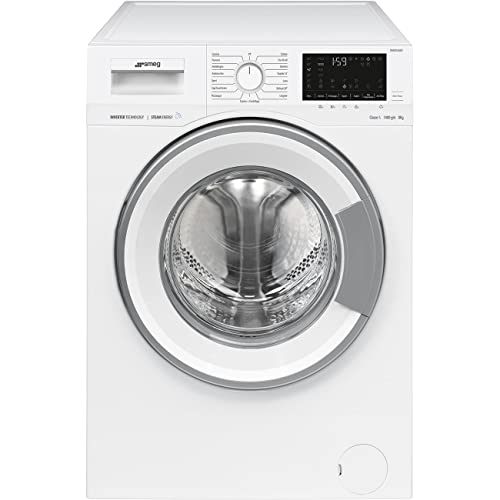
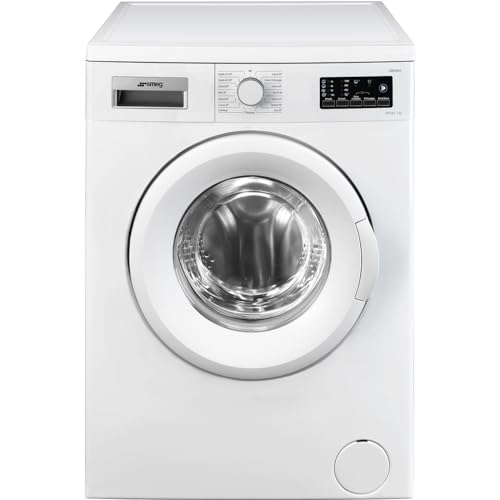
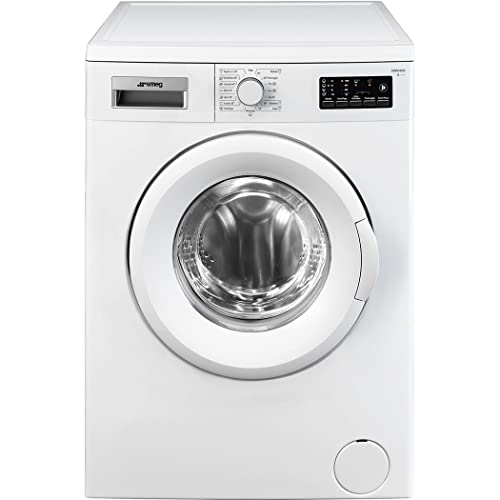
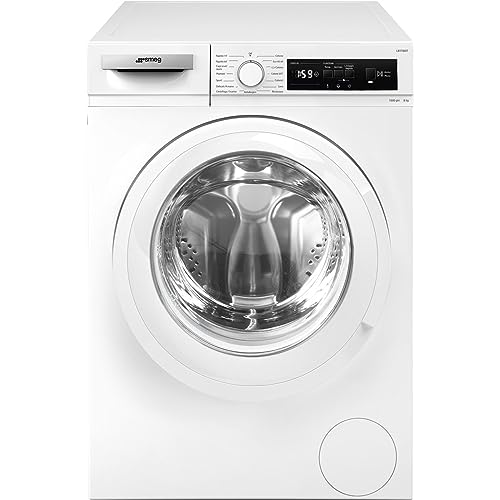
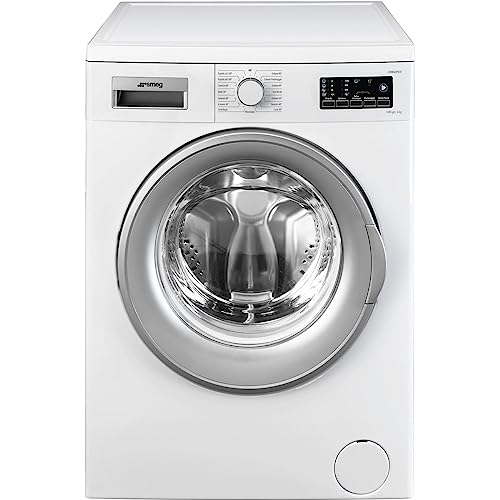
When selecting the best Smeg washing machine, consider factors such as capacity, drum volume, dimensions, energy consumption, water consumption, spin efficiency, noise levels during washing and spinning, motor type, and available washing functions and programs.
What capacities are available for Smeg washing machines?
Smeg washing machines have capacities ranging from 5 to 8 kg, with an average around 6 kg. A 5 kg capacity is ideal for an individual or couple, while an 8 kg capacity is perfect for a family.
The chart below shows the distribution of capacities for Smeg washing machines.
[pie-chart-40332655]
The drum volume ranges from 40 to 55 litres, with an average of 44 litres (lower than the market average of 58 litres). The depth of Smeg washing machines ranges from 40 to 56 cm, making slim models available. Since there are no top-loading models, the standard width of approximately 60 cm is common to all Smeg washing machines.
What is the energy efficiency of Smeg washing machines?
Smeg washing machines have lower energy efficiency compared to other brands. Most Smeg models fall into energy efficiency class D, which is less efficient than the market average, where 39% of washing machines are class A.
The energy class distribution for Smeg washing machines is shown in the chart below.
[pie-chart-58456846]
Energy consumption for Smeg washing machines ranges between 47 and 73 kWh per 100 cycles, with an average of 65 kWh. This places them among the higher consumption models, given the market average is approximately 55 kWh per 100 cycles.
Regarding water consumption, Smeg washing machines use between 37 and 48 litres per cycle, with an average of 43 litres (lower than the market average of 46 litres).
What is the spin efficiency of Smeg washing machines?
Smeg washing machines have spin efficiency classes of B or C. In comparison, the most common spin efficiency class on the market is B, which covers 85% of the market share.
Spin efficiency indicates how well the washing machine removes water from clothes during the spin cycle, an important aspect for drying performance. This parameter is closely tied to the maximum spin speed, which affects the residual water amount at the end of the cycle.
Smeg washing machines have maximum spin speeds ranging from 1000 to 1400 rpm, with 1000 rpm being the most frequent value. This is lower compared to many other brands, where 60% of washing machines reach 1400 rpm and 22% reach 1200 rpm.
Smeg washing machines have a minimum spin speed of 600 rpm. However, they cannot achieve the lower speed of 400 rpm, which is essential for very delicate items like wool. This makes them less suitable for those who frequently wash delicate garments. If you often wash delicate items, consider other brands that allow for the lower speed of 400 rpm.
How noisy are Smeg washing machines?
Smeg washing machines have spin noise levels ranging from 72 dB to 79 dB, with an average of 76 dB (slightly higher than the market average of 75 dB). The spin cycle is the noisiest part of the washing process, so this parameter is crucial for evaluating overall noise levels.
Smeg washing machines fall into noise emission classes A to C. Class A indicates a spin noise level below 73 dB, class B ranges from 73 to 76 dB, and class C covers a range from 77 to 80 dB.
The chart below shows the spin noise distribution among Smeg washing machines.
[vertical-chart-37281994]
During washing, the noise level of Smeg washing machines is generally around 58 dB, higher than the market average of 53 dB. If quiet operation is a priority, consider the noise during washing as well, although it is less significant than the spin cycle.
How many washing programs do Smeg washing machines offer?
Smeg washing machines feature 15 washing programs, a number similar to many other brands. Available programs include Cotton, Cotton Prewash, Eco 40-60, Synthetics, Wool, Hand Wash, Colours, Mixed, Shirts, Quick 60', Quick 15', Anti-Allergy, Jeans, Duvets, and Sports.
The ECO cycle of Smeg washing machines has a duration between 180 and 218 minutes, with an average of 193 minutes (shorter than the market average of 218 minutes). Additionally, these washing machines include 1 or 2 quick cycles under one hour, such as Quick 15' and Quick 60'.
Nearly all Smeg washing machines feature a prewash function, which adds an extra wash cycle before the main one, ideal for heavily soiled clothes, and an extra rinse function, which includes additional cycles to ensure complete removal of detergent residues.
The more advanced Smeg models include the following functions.
- Quick function: reduces the duration of some programs by over 50%.
- Steam function: reduces wrinkles and ironing time for small amounts of cotton, synthetic, or mixed laundry, without stains.
- Anti-crease function: minimizes wrinkle formation by reducing drum movements, limiting spinning, and using higher water levels.
- Anti-crease+ function: the drum rotates for up to 8 hours after the program ends to prevent clothes from creasing.
- Rinse hold function: keeps laundry in water after the final rinse, preventing wrinkles from forming.
No Smeg washing machine includes a silent function, Water+ function, or soak function.
What are the common features of Smeg washing machines?
Smeg washing machines typically include 4-5 features, while the most advanced models offer up to 10 or more. Most models come with systems like foam control, load balancing, and laundry detection. The more advanced versions also integrate features such as overflow protection, self-cleaning, and steam technology. Some models are equipped with inverter motors, which improve energy efficiency and reduce vibrations.
However, Smeg washing machines do not include features such as pre-mixing technology, automatic dosing, automatic drawer cleaning, smart diagnosis, memory settings, energy-saving modes, Wi-Fi connectivity, or AI technology. There is no mention of specific anti-vibration technology or a special drum design for treating delicate items.
Front-loading or top-loading: which type of Smeg washing machine is better?
Smeg washing machines are predominantly front-loading models, with very few top-loading options. If you are looking for a top-loading washing machine, it may be worth exploring other brands.